Pages

29 April 2012

Day 92: Pastry Origami

We had a substitute chef-instructor one day who said baking was a more creative endeavor than the savory side of things, owing to the fact that almost all baked goods are essentially the same: flour, butter, sugar, and some liquid. And while I don't necessarily agree that baking is more creative, she certainly had a point. How could all these things spring from the same ingredients?

I'd counter that baking is more involved on a step-by-step basis. If I forget to season an omelet when it's in the pan, no big deal. In baking, if I mix in a key ingredient too early or too late, it's screwed before it's in the oven.

But of course there is creativity, as I saw when we made dough that can be baked into croissants, danishes, turnovers, whatever. The key was the painstaking (and, apparently, machine-accomplished in professional operations) process of turning dough, which creates alternating layers of flour and butter. When the butter melts, the water evaporates, which is how flaky and buttery goodness comes to be.

The basic idea is to wrap some dough around a big ass block of butter. If you took a cross-section of it, it'd be dough-butter-dough. We then rolled it out and did a tri-fold back in on itself and rolled it flat again – voila, triple the layers (that's dough-butter-dough-butter-dough-butter-dough). And again and again. The painstaking part? The dough fell apart at room temperature, and tore easily, and squirted butter all over the table, so it had to be chilled often before we could work with it again.

But then comes the fun part! We cut it down into 4-inch squares and go crazy. 

Roll them out thin, cut into triangles, and roll from the flat side toward the tip? Croissant!

Fill with almondy goodies, roll into a cylinder, score and bend? Bear claw!

Fill with chocolate, roll into a cylinder? Chocolate croissant!

Fill with jelly, crimp along the edges? Popover!

Cut in from the corners and fold? Pinwheel!

Probably the coolest one: fold into a triangle, score almost to the point, unfold, then cross the margins you've created to the other side and fill with jelly? "Window" or "frame" danish!


And one last thing: the stuff that makes pastries kinda shiny and pretty is called nappage. Basically, it's apricot jelly that's watered down and brushed on after the pastry is baked. Seriously, that's it.

31 March 2012

Day 91: Shortening

I'd occasionally wondered what shortening was, but never why it was called shortening. The reason is, on one hand, maddeningly simple, and on the other, really insightful into some basic baking concepts.

Shortening stops gluten from forming long, chewy gluten chains. In other words, it... wait for it... shortens gluten in baked goods, keeping them in crumbly territory.

As for what it is, it's basically any fat. Butter. Lard. Crisco's website says their all-vegetable shortening is made of soybean oil, fully hydrogenated palm oil, partially hydrogenated palm and soybean oils, and some chemistry-sounding stuff typical of mass produced food.

My chef-instructor pointed out that the frosting on supermarket cakes and cupcakes that leaves that weird film feeling in your mouth is made with shortening.

30 March 2012

Day 89: That New French Bread Smell

French baguettes and an epi ("wheat stalk").
One of the ways I've tried to improve my palate has been to smell everything, and connect ingredients and aromas. A few Christmases back, I made spiced cider for the first time, and it was then I realized that the smell I associated with a freshly baked apple pie was actually nutmeg and cinnamon. Which, of course, are standards on most apple pie recipes.

Our French bread recipe is simple. Five ingredients total: bread flour, water, salt, sugar, and yeast. Specifically, compressed yeast, also known as baker's, cake, or fresh yeast.

The stuff has that vaguely sour smell of feet. The stink wafted throughout our baking lab as we were measuring out ingredients, and went into overdrive when mixed with warm water and sugar to bloom. We'd already used other yeasts in class and, while they have a similar smell, you'd have to shove your nose into the mixing bowl to really get it. (This may be because you need less of the other stuff. The basic substitution is 1 part compressed = 1/2 active dry = 1/3 instant dry.)

And then the stank feet dough gets baked, and that smell transforms into that wonderful, warm, distinctive French bread smell. I turned down two offers on the train/bus ride home to buy my bread.

23 March 2012

Day 87: Beware of Flour

Flour. It gets everywhere.

Tabletops. Hands. Uniforms. Inside my bag. It's the culinary school equivalent of my labrador's fur. Which means the inside of my backpack and most of my jackets have both dog fur and flour all over them.

11 March 2012

Day 86: Attrition

My pastry and baking class began at what is roughly the midpoint of the year-long culinary diploma curriculum (factoring out the three months of externship at the tail end of the program). My group's P&B class fell neatly after Christmas break – new year, different discipline. Walking into our campus' dedicated baking lab brought with it more than a few mild shocks, chief among them: our class was down to twelve people. Three school terms previous, when we started in August, there were nineteen of us.

The number is a little misleading. Two students transferred out of my 2pm class, one into 10am and one into the 6pm slot, to accomodate work. But the others? One person left during Foundations II because of, from what I could tell, a combination of sickness and being in a band. One person, I later found out, decided the culinary program wasn't his cup of tea and didn't show up for the Foundations III finals (he later popped up in the P&B diploma program). Three people straight up did not pass Foundations III, with two deciding to retake the class.

So, here we are. Twelve culinary students in a baking class. Instead of stoves, we have long, metal work benches, a bank of ovens, and random pluggable gadgets scattered about. It was strongly suggested we each bring our own scale. The need for knives is unclear. As a burgeoning cook, I feel like the stove is my true North, so not having one fixed in place is a little strange.

Note: When this blog began, I was posting more or less evenly with my classes. However, at this point, I'm more than an entire term behind. Which means I get a wee bit of hindsight than previous posts may have had, but also, I'm way behind.

18 February 2012

Culinary Foundations III in Review: The Laws of Cooks?

Pancake-flipping robot. Not one of Asimov's.
Isaac Asimov's science-fiction work is famous for the Three Laws of Robotics, rules of behavior that the robot characters would inevitably interpret in different ways. After completing the third of Le Cordon Bleu's three "foundations" classes, it seems to me that cooks should have something similar in place to help us operate. (By the way, Asimov wrote the Foundation series. Coincidence? Er... yes.)

We actually already do. If you consume enough food media, you've probably heard a few operational bon mots from different chefs. One of my chef-instructors paraphrased an oft-held belief in restaurant kitchens: being fast is better than being good. He only had the caveat that a good cook should be both fast and good. A recent Top Chef episode featured one chef saying "fast is slow and slow is smooth" -- in other words, do it right the first time. (Hugh Acheson, however, thought this made zero sense whatsoever.)

I wrote briefly of kitchen multitasking when I was in Foundations II, but in hindsight, those were all simple items. By comparison, Foundations III was a decathlon. Production days typically featured dishes with multiple preparations and techniques. Some days had more than one dish. My most successful days were the ones where I was prepared and efficient. I eventually started timing elements of my chef-instructor's demos so I'd know that, for example, sauteeing mushrooms takes about four minutes, so I shouldn't step away from the stove for six minutes to mince some shallots. I did that. Burned the mushrooms. Had to redo them.

Which brings me back to the Laws of Cooks, which exist but not really. If I had to put them down in stone, they'd probably be something like...

Be Prepared. Know what you need to do before you have to do it. Know when to do it. If something takes 40 minutes to braise, do that first, then go on to chopping stuff. (Thanks, Boy Scouts of America!)

Be Clean. Because shit piles up real fast. I've had a few days where I had to stop and figure out which saute pan at my station was clean and which wasn't. Not a good idea.

Be Organized. I suppose this is the lovechild of being prepared and clean, but it's worth throwing out there. I've had to stop to dig a knife out of my kit because I didn't have them all out together. Not a good idea, though it might make a fun spectator sport.

Be Efficient. I learned real fast never to make one trip for one spice when I could grab all five I'd eventually use. By the same token, don't waste nice knife cuts on something that's going to be removed or strained. Wasted motion is a killer.

Be Fast. It's a carrot, just fucking chop it already.

Food is Done When It's Done. A lot of the chef-instructors love saying this in reply to students asking, "Chef, how long do we cook it?" Mostly because it's true. You can crank up the heat or chop things smaller or whatever, but water boils when it boils, steak sears when it sears, and polenta finishes when it finishes (or doesn't).

Okay, that's a lot of stuff, and not nearly as elegantly tied together as Asimov. Organization is inferred, and efficiency and speed go hand-in-hand, so how about...

Be Prepared.
Work Clean.
Work Smart.
It's Done When It's Done.

I guess I'll see if those work for me moving forward.

Here's a selection of dishes we made in class.

Pan-roasted duck with turnips
Tea-smoked duck breast with ginger-carrot puree (I seared the skin a little much)
Salmon steak with beurre blanc, plus fennel mousseline
Veal blanquette with rice pilaf
Breaded veal escalope (aka veal scallopini)
Sweetbread fritters with tomato sauce, fried parsley

08 February 2012

Day 81: Silly Rabbit

We all have comfort foods. Sometimes its a nostalgia thing, and sometimes it's straight up goodness we're looking for, but either way, it's a combination of flavors that are reliable. As a home cook, I have a subset of comfort foods that are reliable in a slightly different way: they're easy to make. Obviously, I like the way they taste, too, but there are days where I just want to throw something on rice (actually, that's most days) or boil pasta and dump some sauce and cheese on it. It's the doing that puts me at ease.

After my maddening lamb failure, our next dish was lapine a la graine de moutarde (rabbit in whole-grain mustard sauce). We'd be making fresh pasta for it, a task I'd always wanted to attempt but shied away from because it seemed difficult.

It's not difficult. It's super easy. And it's exactly what I needed at that moment in time.

The dish as a whole was also easy. When I read or hear "sauce" in conjunction with a pasta dish, I imagine an old Italian grandmother stirring a slow-bubbling pot of red stuff for hours on end while her plumber son Mario is off saving princesses (apologies to people of Italian descent, but your biggest export to my generation of Americans came from Japan). This sauce was not that.

We slathered the rabbit in yellow and dijon mustard to marinate. We seared it off and braised it. Then we reduced the cooking liquid, added some cream and more mustard to our liking.

Oh, and the pasta. It's also one of those just-that-easy type of things. We made a well in some flour (we used half a cup each of semolina and AP), dropped in an egg and a pinch of salt and scrambled it. Then we started incorporating the flour and eventually kneaded the shit out of it -- it doubled as a decent stress reliever. Then we let it rest (like any other dough, the gluten needs to relax). The hardest part was the amount of water to use. We kneaded until it was smooth, not sticky (too wet) or crumbly (too dry).

We actually did the pasta dough the day prior and kept it wrapped in plastic in the refrigerator. On cooking day, we rolled it into simple tagliatelle-like ribbons cut by hand. If I were a chef, I'd market them as hand-crafted artisan pasta and charge $20 for it, but for a single batch it's actually less fussy doing it that way. We then boiled it in salted water for a few minutes. I used my tongs to grab it, let the ribbons hang over the pot to drain the excess water, then dumped them into the mustard sauce to finish.

My chef-instructor had nothing negative to say about my execution of the dish.

Comfort.

31 January 2012

Bread & Beer

All Le Cordon Bleu culinary students (as opposed to the pastry and baking students) are required to take one pastry and baking class, which I'm in now. My chef-instructor introduced bread making to us by pointing out an interesting fact.

Bread is grain and liquid, and (typically) involves fermentation.
Beer is grain and liquid, and involves fermentation.

So they are, one could poetically/romantically/pseudo-scientifically say, the same thing. They're also two of the oldest foodstuffs in the history of man. Pretty much every culture has their version of each.

Cheers.
Brioche in two shapes: a tete ("head") and couronne ("crown")


27 December 2011

Day 79: Failure Dominoes

The funny thing about the bad days is that they start so well.

During the previous term, I started to write out production schedules for our cooking days to help me multitask.

In Foundations III, we're required to create them. I find them invaluable, since we're now creating complete dishes with multiple elements – protein, vegetable, starch, sauce, garnish – that have to be ready simultaneously. The simple process of writing a schedule helps me organize the tasks I have to do.

The only thing I can't plan for: a complete culinary belly flop.

Today, our dish was roasted rack of lamb with jus, ratatouille, and fried polenta cakes. Individually, pretty straightforward. It went like so:

Three sauce pots go on the burner immediately, two with chicken stock, one with water to blanch a tomato. Cornmeal goes into one of the chicken stock pots. Occasional whisking whilst I also...

Prep all my vegetables. Cube zucchini, cube eggplant, chop bell peppers, mince shallot, mince garlic, mince onion, mince basil. Make a bouquet garni, rough chop some more onion, carrot, celery, and leek for mirepoix. Grate some cheese...

Polenta looks ready. Butter, cheese, salt, whisk, then into plastic wrap, into the reach-in to chill and firm up. Moving along...

The last piece of ratatouille prep is tomato concasser, which means: blanch, shock, skin, core, chop. Then saute zucchini, remove, then the eggplant, remove, then all the minced aromatics and bell peppers. In goes some tomato paste, the tomato concasser, the bouquet, a wee bit of water and to the back burner it goes to stew.

Check the time, clean my station. Still almost 45 minutes until our serving window opens, about 15 until I need to fire the lamb.

Grab my lamb, remove the excess fat and trim off the bones to create that standard rack of lamb look. Start searing the trim for the jus, season the rack with salt and pepper, begin searing it off.

After it's nice and golden, the lamb goes on a roasting rack and into the oven. I allotted 25 minutes to cook the lamb, plus five to rest. I'm right on schedule.

I caramelize the mirepoix with the trim, deglaze, pour in some stock from that third sauce pot and begin to reduce the jus.

Temperature check on the lamb. 95-degrees. I'm aiming for medium-rare, which means take it out at about 130 so it hits 135 or so after resting.

I check and season the ratatouille, strain the solids out of the jus, clean my station some more, feel good. About five minutes later, another temperature check. My digital thermometer shows me...

145... 156... 164!

Way over. Way way over. I yank the thermometer, get the lamb out of the oven, but it's too late. Did I lose track of time? Did I not get the thermometer in all the way? Maybe I screwed up the reading by touching bone? It doesn't matter, I've killed the lamb. No saving it.

Crap.

I move to the reach-in and grab my polenta, unwrap it... and it's paste. It didn't firm up. I undercooked it and instead of a polenta cake, I have corn glue.

CRAP.

I ask my chef-instructor what to do. He helps me spoon and dredge some loose polenta quenelles in flour, plops one into my frying pan. It flattens and cooks up into a semi-crispy pancake. It'll have to do.

Instead of five minutes crisping up my polenta cake, I spend almost 15 trying to turn the paste into polenta quenelles, then change tack and fry them into thin polenta crisps because they won't even hold that football shape. Probably because I put too much cheese; the parmesan is separating and oozing out into the pan.

That's 15 minutes while the lamb is resting, carry-over cooking bringing the temperature even higher.

I salvage three reasonable looking polenta circles and plate them. The ratatouille comes out splendidly, thank God, and then I cut the lamb. The mildest of mild pink color in the center. At least it's not leather.

I mount the jus with butter... and it breaks. Instead of emulsifying into a nice, thickened sauce, the butter creates an oil slick. I didn't reduce the liquid enough before adding the butter.

Screw it. I slap some on the plate and present.

I try not to fret too much about failure. I'm in school, after all, and that's sometimes the point.

Oh, I also randomly burned my wrist. I don't even know how, I just noticed it throbbing on my way home. Later, I'll think about how I wasn't patient enough with the polenta, and too patient with the lamb, and how I put way too much cheese in the polenta, and how I didn't turn up the heat high enough to reduce the jus, and how do I plan for possible disasters like this that unfold like dominoes?

For now, I eat and move on.

The ratatouille was pretty good.

26 December 2011

Day 76-77: Sausagefest

I was both proud and disappointed in myself after two days of making, stuffing, and cooking sausage. Proud because I was on team bratwurst and it was crazy delicious. Disappointed because in two days I didn't make a single sausagefest joke. Not one.

Maybe it was because our chef-instructor chided the room when he was demonstrating how to encase sausage meat and a few of my fellow classmates let loose with some laughter. Juvenile? Sure. But I was still hopeful I'd get in one inventive nugget about, oh I don't know, twisting my meat, or hanging it loose, or what have you.

Anyway, sausage. The basic recipe for any sausage is meat (or, I suppose, a meat-like vegetable doppelganger), fat, curing mix, spices, herbs, and aromatics. And they aren't kidding about the fat. Most sausages are emulsifications of meat and fat. Kind of like a vinaigrette, except you can stuff it into something and cook it and be thoroughly satisfied eating it with a beer.

The bratwurst I got to make is classified as a 5-4-3 sausage. Five parts meat and four parts fat emulsified with three parts ice, to add moisture and also to keep the sausage from cooking while it's run through a buffalo chopper. In our case, the meat was veal. And the fat? Bacon.


Bratwurst on the left, frankfurters on the right. Sweet and spicy italian sausages in the back.

Sausage party!

23 December 2011

Day 74: That'll Do, Pig


I don't know what it is about the faces of mammals, as opposed to fish or lobsters, that makes butchering such a visceral experience. Certainly part of it is that their faces are much easier to anthropomorphize than, say, the cartoonishly flattened look of a flatfish. Mouth, nose, ears, even the body of a four-legged animal isn't that far, anatomically, from us.

For me, it was the eyes of our wee little piggy, stuck wide open, that made my stomach squirm as my chef-instructor's saw came down to behead him, briefly making me want to break out into a soulful rendition of Sarah McLachlan's "Angel" while the camera slowly pushes in on Babe's winsome, albeit dead, eyes.

The momentary uneasiness isn't nearly enough to shift my moral compass on the issue of stuffing my face with delicious animal protein. But I feel like I now know what all the farm-to-table, squeak-to-squiggle chefs are talking about when they wax poetic about respecting ingredients. I will certainly try not to let any more delicious cheeks go to waste going forward. In other words, sisig party!


Once the head was off, pig fabrication quickly shifted into pork lover's magic food porn time as one cut after another became visible. Count a few ribs in from the rear (to keep the tenderloins intact) and slice through the spine. Legs off through the joints. Then separate the tenderloins, sirloins, and ribs.

Just like that, I was staring at kalua pork, baby back ribs, St. Louis ribs, spare ribs, pork belly, pork chops, and ham. Really, how can you say no to any of that?


And then we chopped the head in half to expose the brain.

Squeak.

Squiggle.


22 December 2011

Kitchen Lingo: 'Blanch, Shock, Drain'

Blanch, shock, drain
alternately: BSD

verb(s): To immerse an ingredient in boiling and, typically, salted water to partially cook. To then remove the ingredient from the boiling water and immediately place in ice water to stop the cooking process. To then remove the ingredient from the ice water to dry before it is integrated into a dish.
I suppose this could be three different kitchen lingo posts, but one generally doesn't blanch without shocking or shock without draining. That's how they roll.

Examples of BSD include green beans that will be used in a salad or asparagus before pouring on some hollandaise. It has the added benefit of setting the colors of produce. Because who wants pale, grey green beans?

Longbeans.

21 December 2011

Day 69: The Tomahawk and the Paring Knife

The beef rib primal. Cut #103 if you care to order it in all its glory.
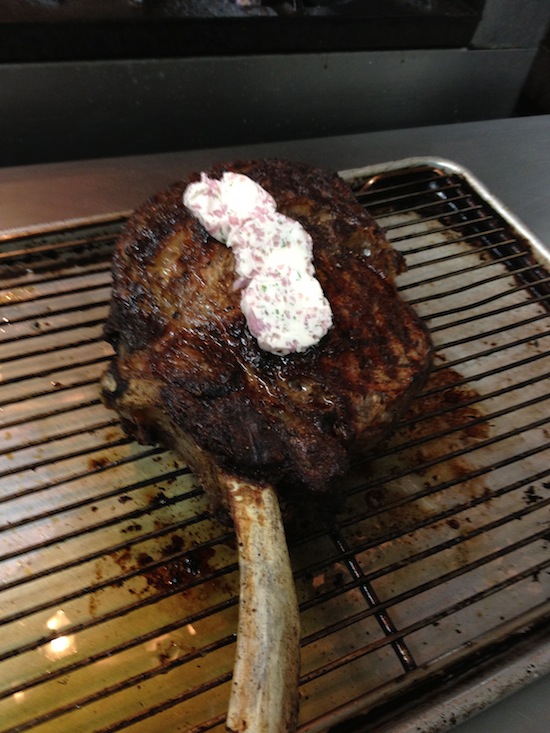
With beef, my preferred method for checking doneness is giving it a quick poke to test firmness. Unfortunately, when it comes to Fred Flintstone-sized cuts of steak, like the bone-in ribeye tomahawk steak, this will not do. The meat is too thick for this to be completely accurate.

We basically had three other methods for checking. There's the decidedly unsexy yet thoroughly practical thermometer method, the crude cut-it-open-on-the-bottom-and-see method, and then the method for the wickedly cool among us: jabbing it with a paring knife and feeling the temperature of said knife with your lips.

Seriously, how cool is that? Of course, for a novice like myself, it didn't turn out perfectly, as my ginormous hunk of weaponized cow ended up medium rather than the desired medium-rare. Still, the gist is this: insert a paring knife halfway down into the steak. Preferred point of entry is the non-presentation side a.k.a. whichever side will end up touching the plate. Give it a few seconds, then remove and place the flat of the knife against your lip.

A lukewarm to warm knife reflects a steak that's in the medium-rare to medium range, which is how one should eat this particular region of bovine musculature.
Cote de boeuf with beurre marchant du vin.

20 December 2011

Day 68: What the Kitchen Saw Thinks

A saw in the kitchen doesn't have a whole lot of uses. Thus...


When you think about it, it really should say, "I hate beef bones and really tough connective tissue!" but never you mind. The kitchen saw giveth things like tomahawk steaks.


Thank you, kitchen saw.

Day 65: Taking Fish By the Guts

Fabricating fish is, technically, a simpler process than fabricating chicken. However, two things make me never want to buy fish whole, no matter how much more economical it might be: scales and guts.

Scaling – descaling? – a fish is, again technically, pretty easy. Hold fish, sweep from back to front with knife, scales fly off. Therein lies the sticky, smelly rub. The scales fly everywhere. It's like an explosion of whatever fish scales are made of. They have amazing range and even better stickiness. I was scratching an itch several hours after the fact only to realize I had a single fish scale dried to my forearm.

Oh yeah, there are also the scales on top and bottom. The ones right next to the dorsal and pectoral fins, which have spiny protrusions that provide structure and can also poke right through your skin.

The other issue is the guts, which tend to stick to each other. There is only the matter of not slicing them open and unleashing whatever nasty stomach contents or green glandular fluids inhabit them.

Other than that, pretty easy. Score behind the fins, knife open the belly, yank and pull guts, follow the bones to fillet. Or you could simply buy fish in many of its fabricated market forms, which we also learned about.

Fun fact: a fish with its head, tail, scales, and guts removed is referred to as a "dressed" fish, in spite of the fact that it is most certainly as undressed as a fish can be before it officially becomes a steak or fillet.

Thank you, Internet.

16 December 2011

Food in Fiction: Boogie Nights

One of the things I love about Boogie Nights is how so many of the sequences can stand alone as brilliant little short films featuring quirky characters. Dirk coming up with his name. Little Bill and his wife. And Buck, played by Don Cheadle.

Buck isn’t the most quotable or memorable of the Boogie Nights characters. That’s probably why I like him so much. Hopelessly behind the trends. Passive aggressively in need of love. A sucker for seasonal novelty food. I can sympathize with the guy.

(Violence, language, and spoilers ahead)


Donut Boy (Dustin Courtney), Man With Gun (Allan Graf), Robber (Jose Chaidez)
Boogie Nights (1997)
Written & directed by Paul Thomas Anderson

09 December 2011

Food in Fiction: Home Alone


Kevin (Macaulay Culkin), Pizza Boy(Dan Charles Zukoski), Johnny the Gangster (Ralph Foody)
Home Alone (1990)
Written by John Hughes
Directed by Chris Colombus

06 December 2011

Day 63: Poultry is My Oyster

You know when cartoon characters are hungry and imagine other characters as food?

That's a little what it's like to suddenly know how to break down – or fabricate, as we say – chickens and ducks and pretty much any type of poultry. It's actually pretty simple: either removing meat from bone or going through joints.

The hardest part is the oyster, the little round bits of meat above the thighs on the lower back of the chicken, which are spoken of lovingly by people. It's requires a little digging with a knife, which is slightly tricky, but really isn't.

We also learned some basic classifications that you sometimes see at the store. They never registered with me before, but apparently they do mean something. A cornish hen is a 5-6 week old chicken. A broiler or fryer is a 9-12 week old chicken. A roaster is 3-5 months.

Knowing is half the battle.

Photo: Tony Cenicola/The New York Times

Kitchen Lingo: Bouquet Garni

Bouquet Garni (boo-kay gar-nee)

noun: A bundle of herbs that are used to flavor stocks and soups and removed before serving. Typically, parsley stems, celery, thyme, and a bay leaf wrapped up in the green portion of a leek and tied together. The herbs can also be sandwiched together between two celery ribs or wrapped up in cheesecloth.

02 December 2011

Food in Fiction: The Matrix


Mouse (Matt Doran), Neo (Keanu Reeves), Switch (Belinda McClory), Apoc (Julian Arahanga)
The Matrix (1999)
Written & directed by Andy and Lana Wachowski

For me, this is the best possible explanation for why everything tastes like chicken.