Pages

Showing posts with label cooking techniques. Show all posts

22 December 2011

Kitchen Lingo: 'Blanch, Shock, Drain'

Blanch, shock, drain
alternately: BSD

verb(s): To immerse an ingredient in boiling and, typically, salted water to partially cook. To then remove the ingredient from the boiling water and immediately place in ice water to stop the cooking process. To then remove the ingredient from the ice water to dry before it is integrated into a dish.
I suppose this could be three different kitchen lingo posts, but one generally doesn't blanch without shocking or shock without draining. That's how they roll.

Examples of BSD include green beans that will be used in a salad or asparagus before pouring on some hollandaise. It has the added benefit of setting the colors of produce. Because who wants pale, grey green beans?

Longbeans.

21 December 2011

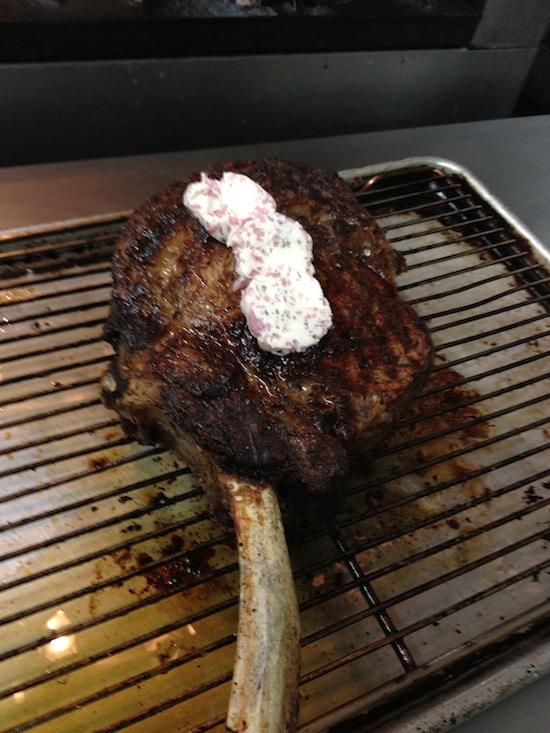
Day 69: The Tomahawk and the Paring Knife

The beef rib primal. Cut #103 if you care to order it in all its glory.
With beef, my preferred method for checking doneness is giving it a quick poke to test firmness. Unfortunately, when it comes to Fred Flintstone-sized cuts of steak, like the bone-in ribeye tomahawk steak, this will not do. The meat is too thick for this to be completely accurate.

We basically had three other methods for checking. There's the decidedly unsexy yet thoroughly practical thermometer method, the crude cut-it-open-on-the-bottom-and-see method, and then the method for the wickedly cool among us: jabbing it with a paring knife and feeling the temperature of said knife with your lips.

Seriously, how cool is that? Of course, for a novice like myself, it didn't turn out perfectly, as my ginormous hunk of weaponized cow ended up medium rather than the desired medium-rare. Still, the gist is this: insert a paring knife halfway down into the steak. Preferred point of entry is the non-presentation side a.k.a. whichever side will end up touching the plate. Give it a few seconds, then remove and place the flat of the knife against your lip.

A lukewarm to warm knife reflects a steak that's in the medium-rare to medium range, which is how one should eat this particular region of bovine musculature.
Cote de boeuf with beurre marchant du vin.

23 September 2011

Day 29: Basic Presentation

It was fitting that our last day of Culinary Foundations 1 featured a basic lesson in plating, or as the French say, le cuisson fancy dancy. It was the first time and, probably, the last time the term "negative space" will be used during my cooking education.

Obviously, this isn't something one normally does at home. However, presentation was my first recognition that there was more to food than cooking and eating, and I've always been fascinated by how TV chefs drizzle a little sauce here and stack a little there and come up with a visual that equals anything you'll find in a modern art museum. Better, in fact, because you can A) take a picture of it, and B) eat it. Everybody wins.

Our chef-instructor demonstrated four plating styles using the same ingredients: chicken, carrots, red and green bell peppers, couscous, reduced chicken stock, and basil to garnish.

Traditional plating
Basically, the entre at 6 o'clock, starch and vegetables at 10 and 2, the sauce over the entre, and garnish really tying the room together. If the clock metaphor looks wrong in the picture, that's because I took it from the side.

Nouvelle plating 
Circa 1960-70s. The sauce goes down first, with the other ingredients "floated" over. Entre goes over the starch in dead center, with the vegetables and garnish artfully splayed out around the circumference of the plate.

Stacked plating
Apparently, three things reached meteoric heights in the 1990s: gangster rap, alternative rock, and food on plates. The entre goes over a mound of starch with the vegetables arranged to give the appearance of structure and height. Sauce is drizzled artfully and the garnish is placed similarly to how skyscraper architects would place an antenna atop their buildings just to nab a new world record. I'm looking at you, Willis (née Sears) Tower.

Displacement plating
Displacement is our chef-instructor's term. I think These Ingredients Don't Like to Share plating also works. Here, the entre takes up the center, and every other ingredient takes their ball and goes to their room. Also, square plate!

17 September 2011

Day 22: How to Save Hollandaise

A few weeks back, I tried and failed to make hollandaise sauce. I'd read in several places that one could save a broken hollandaise by adding warm water a little at a time and whisking like your life depended on it. As it turns out, this is not the case.

For the record, my hollandaise in class didn't break – apparently, recipes that say to make your sauce over low heat are chock full of lies. Get water boiling, then place your double boiler and turn the heat off. So that helped.

But if it did break, we were taught to get a new bowl, whisk a new egg yolk, then stream the broken sauce into the new bowl. A few people did this and it worked just fine.

Ideally, once saved, one should have a poached egg to drown in your luscious, creamy, buttery sauce.

07 September 2011

Day 16: Some of This, Some of That

When I first started cooking "seriously" at home (I guess that means when I stopped leaning on prepared stuff), I started to understand how cooking was, at a very basic level, part art and part craft. Which is to say I started to understand that recipes didn't need to be followed to the letter – that'd be the art – as long as certain things were done properly.

This notion has only grown in my early stages at culinary school. We were given a book of recipes, but it took nearly a month and a throwaway statement from our chef-instructor to remind me I even had it. So far, when I'd replicated a cooking demo at home, I'd just referred to my (sometimes out-of-focus) cell phone pictures that detailed a basic process.

For example, here's the "recipe" for navarin d'agneau printanier (lamb stew with spring vegetables) in picture form.


Basically: sear the lamb, add veal stock, braise. Obviously, this is a shorthand for someone who has seen it done. But here's the basic braising process as I copied it into my notebook:
  1. Prep protein - trim fat and waste, season and partition
  2. Sear - in hot fat until brown on all sides (remove)
  3. Sweat - aromatics, mirepoix, garlic, shallots (until translucent)
  4. Pincer - addition of tomato product
  5. Singer - flour (rain in)
  6. Deglaze - liquid - dissolves any particles at bottom of pan
  7. Simmer - cover, braise
That's the basic craft. As far as not following recipes to the letter, we didn't remove the lamb from the pan to sweat the aromatics, and we only had onions and garlic, no mirepoix or shallots. Measurements are nowhere to be found. (By the way, chilled veal stock has the consistency of gelatin. It just goes to show, there's always room for Jell-o!)

I didn't even take pictures of the spring vegetables, which were glazed. I jotted down the following notes:
cold water, simmer, reduce more than half, butter, sugar, reduce
That's it. Really.

Earlier tonight, I practiced by knife cuts on a carrot, and then used that very basic of recipes to make glazed carrots. It turned out pretty well.

This is probably why I prefer cooking to baking. There isn't enough room in my head for precise measurements, but processes are manageable. What's not to love about "butter, sugar, reduce?"

01 September 2011

Day 14: Monter au Beurre

The butter we didn't use.
"This is not a healthy cooking school."

Our chef-instructor was making two simple pan gravies from the drippings of roasted chicken and roasted guinea fowl. In went some stock, garlic, and some other herbs. He reduced both and explained monter au beurre, proof again that everything sounds glorious in French.

Monter is mount. Beurre is butter. So, basically, monter au beurre means add the caloric equivalent of a solid fuel rocket booster to enrich and finish a sauce. "This is French cooking," said our instructor.

And it was good. Really good.

We did more tournés today, which we actually roasted, somewhat mitigating my mounting contempt for tournés. They're like crispy little blimps.

We also minced parsley, a sneaky hard task if done properly. In the past, when I've chopped/minced parsley, it always ended up a little moist, and today I learned why. A standard up-and-down rocking chop on parsley results in bruising the leaves, causing moisture to leech out. Adding a little forward-backward slicing motion helps avoid this, and enabled us to make a dust-like minced parsley that's much easier to sprinkle.

On roasted chicken, say, or butter-enriched pan sauce. Like how the French do.
Guinea fowl pan sauce with pearl onions and, yes, finished with butter.
ETSJ2B792KWM

26 August 2011

Food in Fiction: Goodfellas

"In prison, dinner was always a big thing. We had a pasta course and then we had a meat or a fish. Paulie did the prep work. He was doing a year for contempt and he had this wonderful system for doing the garlic. He used a razor and he used to slice it so thin that it used to liquify in the pan with just a little oil. It's a very good system."

Henry Hill (Ray Liotta)
Screenplay by Nicholas Pileggi & Martin Scorsese, based on Pileggi's book Wiseguy
Directed by Martin Scorsese

Paulie's thin slicing technique is properly called émincer.

Watch the dinner scene on YouTube (sadly, not embeddable)

25 August 2011

Technique: Cooking Beef to Desired Doneness

Epicurious has produced a bunch of technique videos, including one that is hands down the best guide I’ve ever come across for how to tell the doneness of a steak without using a thermometer or (shamefully) cutting it open.

In fact, in the category of all-time hand-related techniques, I'd rank this just ahead of the finger multiplication in Stand and Deliver and just behind Steve Jobs' insistence that the iPhone should eschew a stylus and utilize a touchscreen.

The basic gist is to compare the tenderness of beef to the tenderness of the flesh at the base of your thumb. The tenderness with your palm open is raw. Touch your index finger and your thumb and then test again; it should be slightly tougher. That's rare. Middle finger and your thumb is medium-rare, etc. Genius, right?


24 August 2011

Day 8: 'Chinaman' is Not the Preferred Nomenclature

Today was day eight, but only our fourth day in the kitchen (we alternate between our kitchen "lab" class and Food Sanitation & Safety). Which is why I was surprised to crack open my culinary foundations book and realize how many knife cuts we've already done. In roughly ten hours of class, we've tackled:

Zucchini, potato, and celery tournés.
  • Brunoise (1/8" cubes)
  • Macédoine (1/4" cubes)
  • Parmentier (1/2" cubes)
  • Juliènne (1/8" x 1/8" x 2" sticks)
  • Batonnet (1/4" x 1/4" x 2" sticks)
  • Rondelle (round slices)
  • Tournés (football or boat shapes)
  • Concasser (rough chop)
  • Émincer (really thin slice)
  • Bouchon (cylinder)
  • Savonett (rounded discs)
  • Partridge in a Pear Tree (not really)

…phew!

I am getting slightly better with eyeball measurements, which feels good. The most challenging part for me thus far has been squaring off vegetables, that initial step to make even sides before cutting down into the desired shape. I haven't quite made an even square yet, which screws up the whole deal before I've even begun, and results in a lot of waste as I try to shave the potato or carrot or whatever into a proper square.

We were officially introduced to a bunch of "small ware" today. Pots and pans, basically. I was glad to learn that one of the head chef instructors refers to sauce pans as sauce pots, which makes a lot more sense. And then we learned that two conical strainers have… er, antiquated cultural names.


Chinois, the really fine mesh sieve, is simply French for Chinese. Based on that name, I'd assume it was invented and/or popularized by Chinese cooks. But then the other one is named China Cap, and I'm thinking the name probably wasn't given by those same Chinese cooks.

Honestly, the name China Cap tickles me. It's cute in the same way a latently racist great grandmother is cute. "Oh, she doesn't mean anything by it," you say. "That's just what they called conical strainers in her day." Hey, it works. 

23 August 2011

Day 6: Have Knife, Will Practice

3-2-8-2-2-4

No, that isn't Jenny's number. Or Hurley's Lost lottery digits (well, one is). It's probably the easiest way to remember kitchen volume conversions I've seen. It goes from smallest to biggest.
3 tsp = 1 Tb
2 Tb = 1 oz.
8 oz. = 1 cup
2 cups = 1 pint
2 pints = 1 quart
4 quarts = 1 gallon
So, that's pretty nifty.

In other news, we practiced more cuts. A lot more. I think I have effectively quadrupled my French vocabulary. Merde oui!

I haven't been completely satisfied with my cuts. The squares haven't been quite square enough. I've found that the bigger dices are actually more difficult, I think because it requires a steadier hand to make the longer cut.

The good news is we can take home ingredients to practice, so I grabbed two potatoes. Once home, while making dinner, I busted out a tape measure to practice my macédoine (1/4") cubes. Of course, I didn't want to throw food away, so macédoine potatoes, olive oil, garlic and a little thyme and I had myself some fancy, not-so-brown hash browns to go with some steak and heirlooms from the garden.


21 August 2011

Week in Review #1 - Let Them Eat Pasta

The first week of culinary school is in the books. A basic foundation-laying process has begun.

And of all the things that I’ve learned, one thing jumps out: the French didn’t really invent modern cuisine. As a red-blooded American, I feel it’s my duty to take every opportunity to cut down those peace-mongering surrender monkeys.
"We all talk like Maurice Chevalier!"

I kid! I kid! But let's face it, there's a strange allure to poking fun at the French.

It’s fun to, how you say, ooze theez reedeecooluhs ahk-cent. It’s fun to add “le” to things to make them fancier. Even though American involvement in war is a lightning rod of a subject nowadays, can any one of us resist pointing out how we saved the French twice last century? And they lost Vietnam, too!

So, if you’d like to get under the skin of the resident Frenchman in your social circle, do try to work this into a dinner conversation: French cuisine was brought to France by an Italian.

Of course, this is a gross simplification that ignores all the innovations the French brought to the modern, professional kitchen, but it’s essentially true. Catherine de’ Medici, she of the Famiglia de’ Medici (cue your ridiculous Italian accent), married King Henry II of France in 1533. She brought her cooks and their more sophisticated techniques with her.

It wasn’t until the next century that a French chef, trained in a Medici kitchen, decided to break away from Italian conventions, kickstarting a series of changes that eventually resulted in haute cuisine, the brigade system, restaurant terminology and all that stuff.

Okay, so it’s not even “essentially” true that French cuisine was brought to France by an Italian, but hey, it’s all in good fun. And besides, we all know the Chinese invented everything.

Technique of the Week

My new rule of thumb: give it the finger.

One of the essentials of slicing and dicing is uniformity. Our cutting boards do have ruler hash marks on the bottom, but moving ingredients to the edge slows me down. The most basic measure we’ve had so far is half an inch, because from there you can cut down to a batonnet (1/4" sticks) and a julienne (1/8" sticks).

To help me eyeball the measurements, I went home and measured my fingernails. It turns out my middle finger nail is half an inch from the back to that line where the nail meets skin (as opposed to the end of the nail, which, of course, grows). If I'm ever in a kitchen with you, please don’t take it personally.

Injury Report

One week, zero cuts. I did scratch myself at home on, of all things, the little metal teeth on a box of parchment paper, but I don’t think that counts.